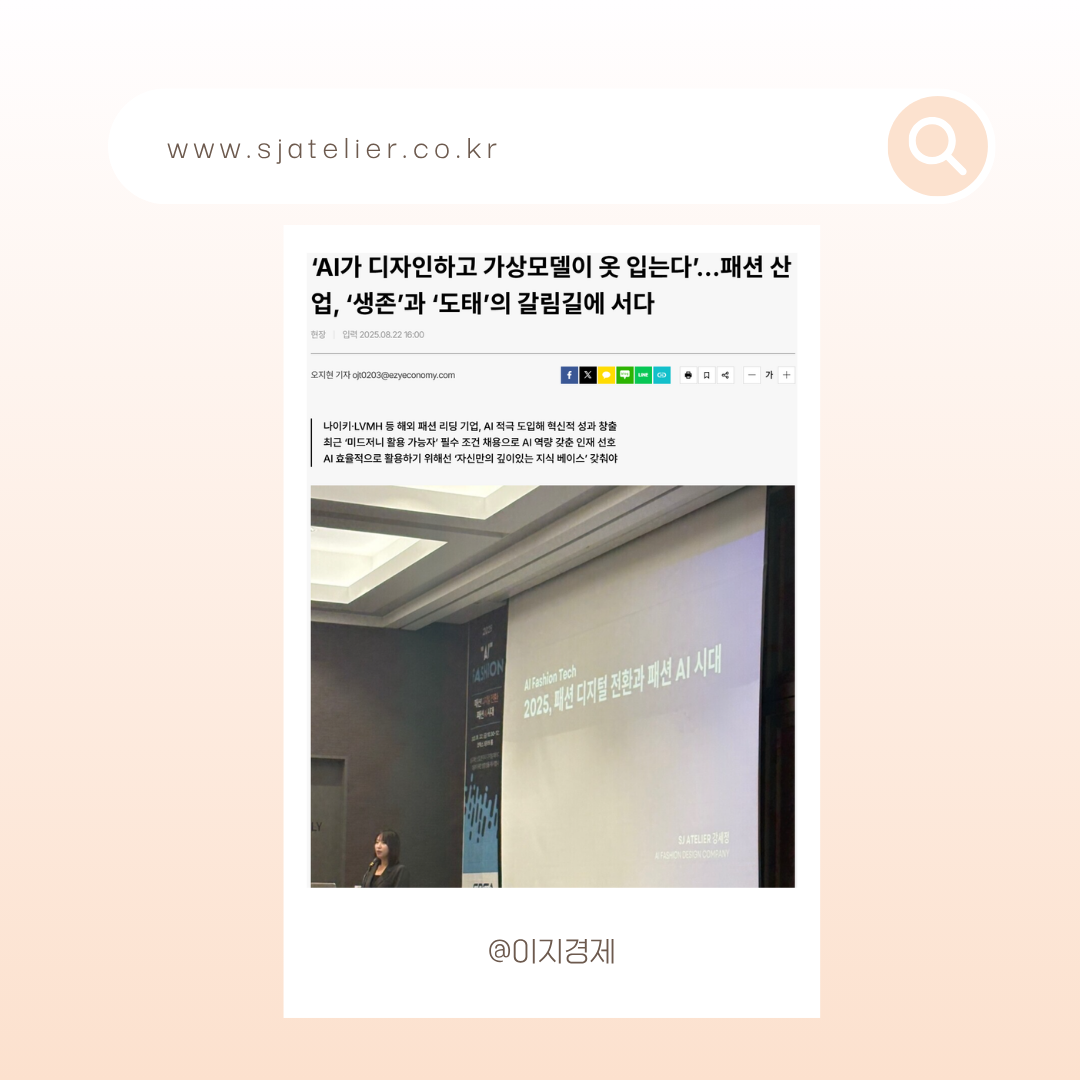
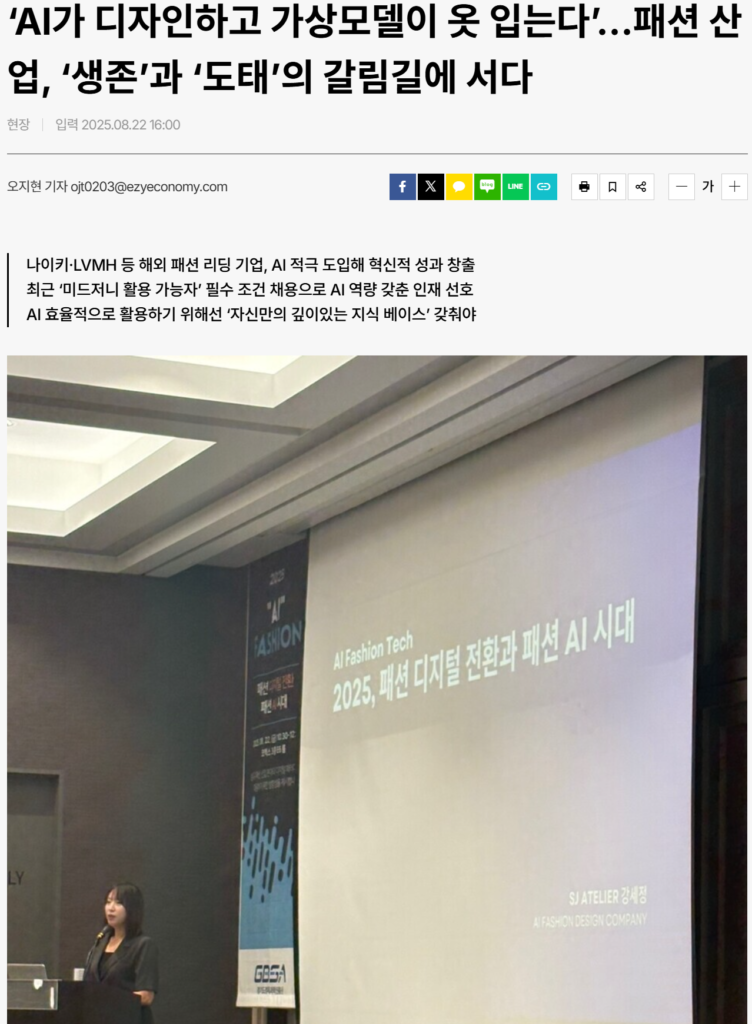
“AI Designs, Virtual Models Wear”: Fashion at a Crossroads between Adaptation and Obsolescence
Planning that once took three months now takes one, while new designs emerge beyond what people had imagined.
At the same time, some design jobs are disappearing.
AI is no longer a distant technology; it is a present reality shaping the fashion industry’s survival.
“2025 Fashion Digital Transformation and the Era of Fashion AI,” organized by the Gyeonggido Business & Science Accelerator, took place on the 22nd in Conference Room E6 on the third floor of COEX, Gangnam, Seoul. Drawing on twenty years of fashion experience, SJ Atelier CEO Sejeong Kang discussed how AI is reshaping the industry.
Recent AI advances have exceeded expectations. Services such as VIIM Studio can dress virtual models from an uploaded clothing photo. Short text prompts can now produce high-quality images and videos.
The report cites global research projecting 42% annual growth in the generative AI design market and an AI contribution of USD 275 billion to fashion by 2028, giving an approximate conversion of KRW 3,850 trillion. It also reports that fewer than 30% of Korean fashion professionals actively use AI and more than half do not use ChatGPT.
Leading global fashion businesses are advancing their AI efforts. The article reports that Nike cut product development time by over 60%, while LVMH is training AI on brand identities across trend analysis, production and inventory. Mango nearly sold out its first AI-created collection, and Zara and H&M are using AI in design to shorten new-product cycles.
Major Korean companies are also moving quickly. F&F established a dedicated AI team, with its chairman taking a direct interest in AI design. It made Midjourney use mandatory for designers and introduced AI across planning, marketing and design. Its recruitment notices also list Midjourney proficiency as a requirement, highlighting the growing importance of AI skills.
Many Korean fashion workplaces still hesitate to adopt AI, citing lack of time or disappointing initial results. Kang warned that the gap between users and nonusers is widening rapidly, and that dismissing AI after limited experimentation risks falling behind.
Businesses adopt AI primarily to save time and money. There have been cases of reducing a designer’s labor costs after adopting AI. As individuals can now produce advertising imagery and videos in a week at a fraction of their former cost, marketing roles are also changing and shrinking.
Heuritech, used by Nike and LVMH, analyzes three million social media images a day to identify trends. Planning based on intuition alone is becoming less effective. With AI learning from paid trend reports, expert-style analysis is increasingly accessible.
How can fashion professionals adapt to the AI era? Planning based on real-time data is one key. Asking AI effective questions and critically evaluating its output require more than technical knowledge. A deep personal foundation in fields such as the humanities, art history and philosophy has become increasingly important.
The speaker predicted a future in which a small number of lead designers direct multiple AI systems. Highly personalized services that analyze individual data, propose tailored designs instantly and connect them to production could become a key competitive area.
Sejeong Kang described AI as an automated research assistant, market analyst and creative partner. She delegates daily research and organization to AI so she can focus on other ideas. Kang emphasized that people who learn and experiment with AI will be able to lead the fashion industry’s future.
Source: EZ Economy (https://www.ezyeconomy.com)
Preview in SEOUL 2025
Fashion AI Seminar Press Coverage
Media
EZ Economy
Year
2025.08.22